

Movement is a gift
Don't let the world take it from you.

“Just gotta keep moving,” my friends tell me. Especially the older friends that move just a little more slowly these days and perhaps with a bit more effort.
And there’s so much truth to that mantra. Movement keeps our bodies working or maybe just confirms for us that they still are. It keeps the joint fluid flowing, the blood from our extremities returning and the communication pathways active from brain to moving part and back again. It may even have a role to play in newly recognized “interstitial” freeways between our body organs.1
So, why are we resisting using something that does us so much good? Resisting, you say? Yes, it’s a trend, perhaps, ahem, a movement. We are in a time where movement and movement sensation are on the outs, being replaced by movement done for us. And we’re not giving it much notice.
Here’s what I mean.
Recently, I was giving a talk about my book, Made to Move, to a church group in Virginia. As always, this was a participational talk. I ask the group to become aware of their breath, their heartbeat, their mind’s focus and the way their strength and stretchiness are related to each other. At one point I ask them to find their pulse, which always ushers in some stammers and looks of concern. But once I demonstrate the way to find their radial pulse (I know they have one because they’re sitting here looking at me!), most folks are relieved to find they have a strong, steady beat.
One man sitting near the front, however, made no effort at all to find his pulse. He just looked at me and raised his wrist. “My apple watch tells me my heart rate,” he said. No need to move. No need to attend to the movement inside me. Technology will do all that for me. Next question.
He completely missed the wonder we were enjoying as we felt the pulsation under our skin and marveled at its constancy and life-giving force.
Then this:
Just yesterday, I was walking along a busy street2 in our town. I had parked in the shade and was making my way along the sidewalk when there was a bit of a traffic backup near the crosswalk. It wasn’t because a pedestrian was crossing; it was because the nose of a car was swinging wide into the lane of traffic to squeeze its rear end into a narrow parking spot right up front.
As I approached, a young family emerged from the vehicle. I complemented the driver on his driving dexterity. “Oh, I let the computer do that,” he said, unapologetically.
I admit it was tempting here to give way to sour grapes … How many hours did I spend practicing parallel parking in order to pass my driver’s test3 …, but I was bigger than this. I simply smiled.
But inside, my concern level was rising.
How much of our know-how and dexterity do we turn over to technology every day?
These two occasions and so many others in my daily doing incline me to raise a ruckus here at Fit2Finish by Dr Wendy. Here, it seems, is where we find ourselves:
—> On the one hand it’s good to move.
—> On the other hand, why bother when it can be done for you more quickly and more accurately with the push of a button?
—> My concern: do we know what we’re missing out on by not-doing?
—> Added concern: people on weight loss drugs are thin now. Who needs to move?
Caveat: I’m delighted people are finding weight loss drugs helpful. But once folks achieve their target weight, they forget that movement isn’t just for weight control.4 It’s essential in so many other ways. Worst of all: the less we move, the less we’re inclined to move. And that, it seems to me, is likely to land us in a world of hurt.
Not just because we’re more sedentary which is awful for our hearts, lungs, and waistlines.
Not just because we’re less self-reliant which diminishes our capability and creativity.
Not just because we’re thinking less which, obviously, is a road to disaster.
But because when we move less, we lose touch with the gifts movement has to offer which are essential ingredients for the health of our body, mind, and soul.
In fact, one might even say that movement ministers to us. So said one of the participants at my talk who enjoyed the reminder that our physical nature can tune us into our spiritual selves. Here’s a look at our group!
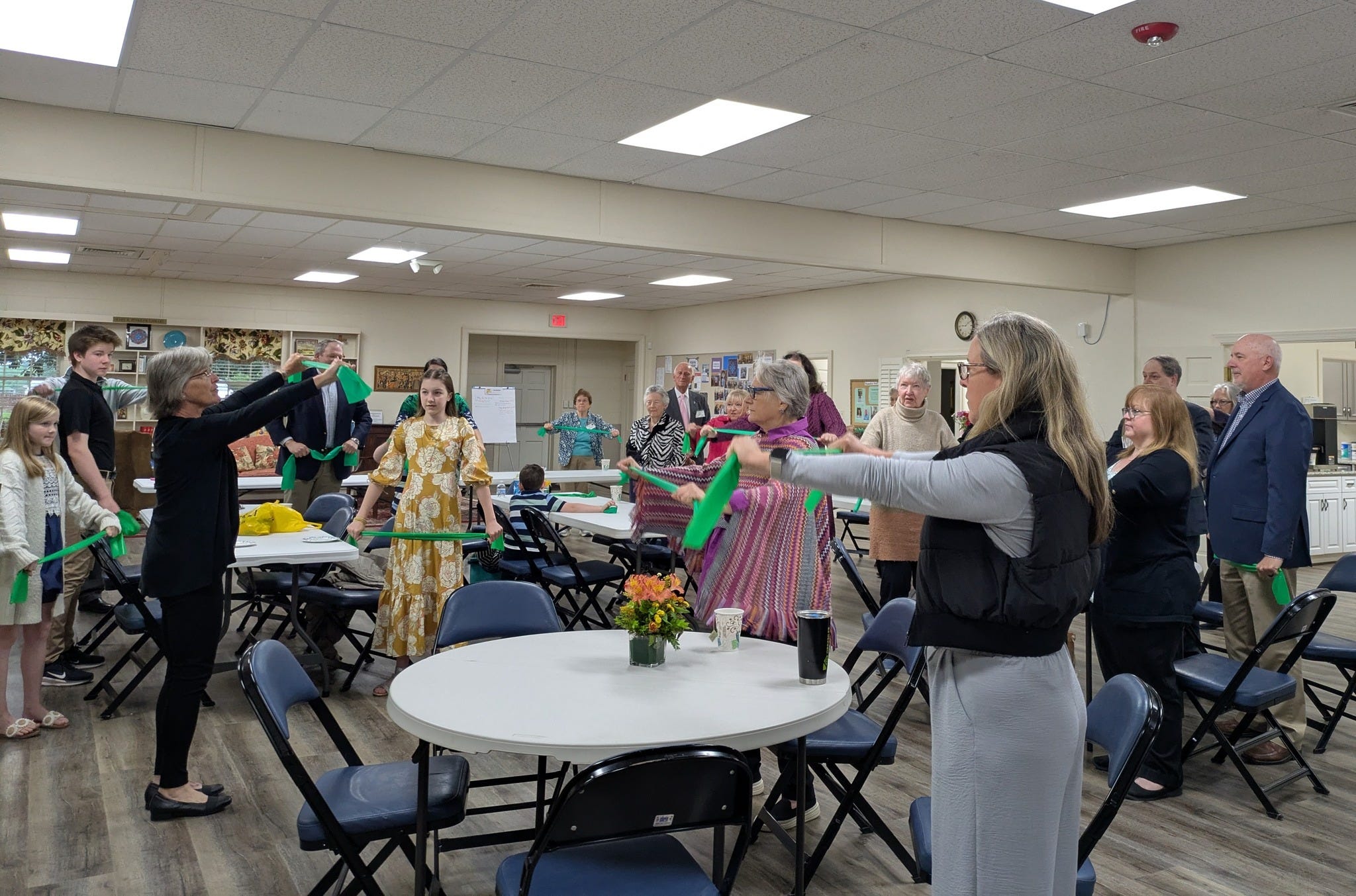
“Ministry,” that feels like a loaded word these days. It doesn’t need to be. Ministering is simply tending to a need. It might be the need of another, or it might be your own need that requires tending to. When we move, we can do both. When we skip or avoid moving, we lose out on both.
Thinking about this, I did a deep dive into things movement does for us.
Movement helps us think and learn.
Movement allows us to sense and experience.
Movement energizes and focuses us.
Movement raises our awareness.
It helps us communicate and express ourselves. Joy and pain never move the same.
Movement activates us and sometimes inspires those watching us.
Movement can pique our creativity and stimulate our imagination.
It can calm us and bring peace.
Movement provides meaning.
Movement helps define and identify us.
Movement can speak for us before we utter a word.
Movement connects us.
Movement invites recreation and playful restfulness.
Some movement is reflexive, automatic and necessary for life.
Some is under wraps until we hold that baby and the rocking begins.
Some things just move us.
Movement is need-tending in so many ways. It’s part of us for a reason. For our physical health, our mental health, our emotional balance, and perhaps even to sense our souls. All are paramount to our wellbeing. When we turn our ability and attention over to the tech lords to do as they wish, we hand them the keys to our needs. And with this go all the skills and thrills we would have scored had we stood our ground.
We have to be participants in our own lives, not simply spectators.
This deep dive into the wonders of movement has left me pondering…
What would life be like without movement?
Some people I know, including some of you reading this, do not (or no longer have) the privilege of full movement of the body they came with. Neuropathy has stolen some. Surgery has interrupted it. Injury, illness or disease has left them with loss of movement, loss of sensation, or even partial paralysis.
How can we willingly dismiss the gift of movement others must go without?
We’ve got to do this together, friends.
This brings to mind a father-son tandem who inspired so many, Dick and Rick Hoyt. Though Rick had cerebral palsy, they competed together in marathons and triathlons, even the Ironman, father pushing son in a wheelchair, bicycle basket or boat. Clearly, they brought each other to life.
Movement is a gift we give ourselves every day. Maybe just don’t call it exercise…
Here are some quick, healthy movement snacks for your day:
Walk the dog or pet someone else’s.
Bend or reach to smell the flowers.
Take one step in a new direction.
Parallel park your own car!
Take your pulse, counting each loving beat.
Take three deep breaths and savor the inspiration.
Eat slowly and taste every bite.
Take your time to do it.
What does movement mean to you?
Inside the Interstitium, the Human Body’s Hidden Pathways - The New York Times
I use the term busy street here very loosely. Here in Williamsburg, VA, busy means there were a couple cars backed up.
To this day, I am a parallel parker, par excellence. Even my family will tell you!
Actually, exercise alone is NOT a good way to manage overweight. Diet management is best for this.
Good for you that you can still parallel park (without technology). I've not had to do it in a very long time, but I'm better at it than my husband 😉
I agree with movement as being a gift. Any time my movement is taken away from me (illness, injury), I'm even more grateful for the days I have it.